Tile Clear - Puzzle Game
- 4.9
- Rating
- 10.00M
- Installs
- Free
- Price

 Analysis by App-foxy
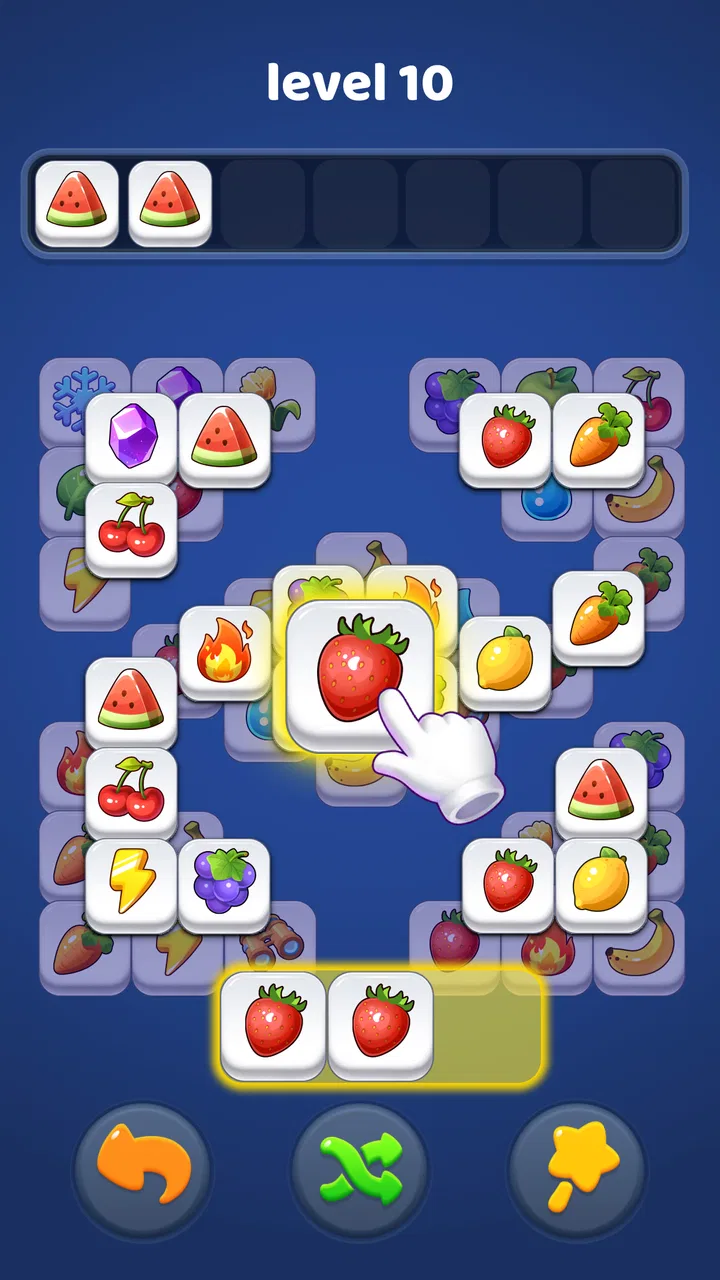
When I first opened Tile Clear, I understood the appeal almost immediately: it puts the board in front of you and asks for one simple kind of attention. You look for matching tiles, clear them, and keep the space under control. There is no complicated story to learn or large rulebook to study. As a puzzle game from Cedar Games Studio, it is built around the pleasure of spotting a useful match and watching a crowded arrangement become manageable again.
That simplicity makes it especially easy to share around a household. Someone can pick it up for a short break, finish a few moves, and hand the device back without needing a long explanation. I can imagine it working well on a family tablet or a phone that several people use at different times, provided everyone agrees on when it is available and understands that progress belongs to the device or game session rather than automatically becoming a separate profile for each person.
The game is free to start and is rated for Everyone, which gives it a broad audience. It supports devices running Android 7.0 or later, and the current version is 1.1.0. Its store summary describes the experience as pure triple-tile matching, and that is the right way to approach it: this is a focused matching puzzle rather than an adventure game, a competitive platform, or a story-driven distraction.
You May Also Like

 Blood Strike: 2.5 Anniversary
Blood Strike’s Loadouts Turn Every Drop Into a Tactical Gamble
A close look at Blood Strike’s custom loadouts: how fast access to signature weapons reshapes its battle royale rhythm, rewards preparation, and narrows the gap between fights.

 Pandora - Music & Podcasts
Pandora’s Music Is Easy to Start, but Harder to Recover
Pandora’s strength is its low-effort path from a seed to a station. Its weak spot is how much confidence it asks you to place in connection, setup, and quiet recovery.

 8 Ball Pool
 Is Built on Rivalries, Rematches, and Routine
A close look at the rivalries, rematches, shared routines, and unanswered safety questions that turn a quick pool match into a persistent mobile community.

 Samsung Music
’s Quiet Strength Is Playing What You Already Own
Its reach comes less from spectacle than from dependable access to a personal library. That simplicity is both the app’s strongest retention engine and its ceiling.

 AccuWeather: Weather Radar
AccuWeather Review: A Quick, Clear Forecast for Everyday Decisions
For everyday plans, the best forecast is the one you can understand quickly. AccuWeather makes rain timing, radar, and local conditions easy to act on, with a few trade-offs.

 Hill Climb Racing
Why Hill Climb Racing Still Turns Crashes Into One More Run
A tiny car, a bumpy hill and one more upgrade: Hill Climb Racing keeps resurfacing because its simple chaos makes every near-miss feel personal.
More From Our News Desk



How Tile Clear Fits Into Shared Household Play
I’d make shared play feel smoother by treating each handoff as a fresh decision: the next person can either continue the current board or wait for a clean start. That small pause helps everyone understand whose turn it is and avoids surprise moves that undo someone else’s plan. It also sets up a useful question for the next section: what makes the matching rhythm satisfying enough to return to?
A puzzle that works in short, informal turns
The strongest household use case is the passing-around moment. One person is waiting for dinner, another has finished homework, and a third wants something quiet before bed. A matching puzzle can fit those gaps better than a game that requires a fixed team, a long round, or constant online coordination. I found that the basic loop is understandable enough for a new player to begin by watching one turn.
That does not mean every player will enjoy it equally. People who like fast reactions, direct competition, or rich exploration may find the repeated sorting and matching rhythm too restrained. Tile Clear is more suitable for someone who enjoys visual order and small decisions. The satisfaction comes from reducing clutter intelligently, not from mastering a large control system.
On a shared device, the short-turn nature also creates a practical boundary: decide whether the next player is taking over the same board or starting a fresh session. That distinction matters because a puzzle can feel relaxing when you are solving your own position, but frustrating when another person changes the arrangement and leaves you to continue without knowing their plan. I would treat each handoff as a clear choice rather than assuming that everyone wants to share one unfinished board.
Why the triple-match rule changes the feel
Matching three tiles sounds straightforward, but the important decision is often what to remove first. Clearing an obvious trio may expose useful pieces, while a different move can preserve options for later. That gives the game more thought than simple visual scanning. I recommend looking beyond the first available match and checking which tiles will become accessible after the clear.
A useful habit is to identify several possible groups before tapping. This reduces the chance of spending a valuable position on the easiest-looking combination. In a household setting, it also makes the game easier to explain: instead of saying “just match things,” I would tell a younger player to look for a trio, then ask what might appear underneath or behind it. That turns a casual activity into a small exercise in planning without making it feel like a lesson.
The trade-off is that the game can become less comfortable when the board demands patience. A player who wants immediate, obvious matches may feel that the puzzle is slowing them down. I prefer that tension because it gives the loop some staying power, but it is also the clearest reason not to recommend this to someone seeking a purely automatic time-killer.
Setting boundaries before the device changes hands
Tile Clear is easy to start, but shared use still benefits from a little preparation. I would first decide whether the device is being used for independent turns or for one communal puzzle. If several people take turns on a single board, agree that the current player gets time to inspect the layout before anyone suggests a move. Otherwise, the most vocal person can end up solving every decision while the others merely watch.
I would also establish a simple rule about purchases before letting children use the game. The game is free, but optional in-app items range from $0.99 to $44.99 per item. That is not a reason to avoid it, yet it is a reason to keep payment decisions with the adult who owns the device or account. A child can enjoy the matching play without being responsible for deciding whether an optional item is worth buying.
Because the game is listed for Everyone, it is a natural candidate for mixed-age use, but an age label does not replace supervision or conversation. Younger players may understand the puzzle while still needing help with device etiquette, turn-taking, and purchase boundaries. I would explain those household rules separately from the game rules.
Keeping progress and expectations clear
One question a shared-device user may have is whether each household member gets a distinct personal space. I would not assume that from the game itself. The safest approach is to regard the visible progress as belonging to the current device or active game context unless the app clearly offers a separate profile option during use. That prevents disappointment if one player continues from another player’s position.
This matters particularly when adults and children use the same phone. A child may think a board was left for them, while an adult may see it as a communal puzzle. A quick verbal agreement solves much of that confusion: either finish your own board before handing over the device, or label the turn clearly and accept that the next player may make different choices.
I also like the idea of using the game as a quiet shared activity rather than a reward that must be earned through constant performance. The puzzles are more pleasant when players can discuss possible moves without turning every mistake into a criticism. If the household atmosphere becomes competitive, the game loses some of its relaxing quality, so cooperation works better than ranking people by how quickly they clear tiles.
Age context, trust, and adult oversight
The Everyone rating makes the game approachable for children, parents, and older relatives who may not be comfortable with action controls. The central interaction is visual and deliberate, so a first-time player can learn by trying. I would still introduce it differently depending on the person: a child may need help recognizing the matching groups, while an older player may appreciate a slower explanation of the board’s available choices rather than a rushed demonstration.
Trust is more important than technical complexity here. A child using a shared phone should know which taps are part of the puzzle and which decisions involve optional spending. An adult should also check the device’s general purchase arrangements before handing it over, rather than relying only on the game’s age label. That is ordinary shared-device care, but this title’s free entry and optional purchases make the conversation worthwhile.
For a household with several children, I would avoid presenting the game as a contest unless everyone enjoys that format. The player who sees patterns quickly may dominate, while a younger player may need more time to inspect the board. Taking turns as a group, with the current player making the final decision, keeps the activity accessible without inventing a competitive system that the game does not need.
What makes it different from other puzzle choices
Compared with a word puzzle, Tile Clear asks for visual grouping rather than vocabulary. Compared with a match-three game, its appeal is less about arranging pieces into a line and more about managing sets of three from the available layout. That difference gives it a cleaner, more tactile feeling. I would choose it when I want to focus on shapes, positions, and order instead of reading clues or waiting for a cascade of effects.
It is also more contained than a typical casual game with a large collection of side systems. That can be a strength on a shared device because there is less for a new player to learn. The weakness is that anyone looking for character development, a long-term narrative, or a broad progression structure may find the experience narrow. Tile Clear earns its place through the quality of its central puzzle loop, so the loop has to be exactly what you want.
For a busy adult, the best comparison is not another specific title but the choice between a deliberate puzzle and a more passive scrolling habit. This game asks me to look, predict, and commit. I can stop after a brief session without feeling that I abandoned a team or interrupted a story. On the other hand, if I am too tired to think about the consequences of a move, the same quiet design can feel demanding rather than soothing.
Small strategies that improve the experience
My first practical tip is to avoid clearing every visible trio immediately. Before making a move, scan for tiles that appear to be blocking several other possibilities. Removing those can open more of the board and give the next decision a clearer shape. This is more useful than tapping quickly simply because a match is available.
My second tip is to use verbal planning when playing with someone else. Say which group you are considering and what you expect it to reveal. That makes the game cooperative and helps a less experienced player understand the reasoning. It also prevents the common shared-device problem where a spectator reaches over and makes a move without explaining it.
My third tip is to pause when the board starts to look visually confusing. Instead of searching randomly, divide your attention into areas and inspect each one for possible triples. This reduces missed matches and makes the puzzle feel less like a cluttered image. It is a simple technique, but it changes the experience from frantic tapping to controlled scanning.
A fourth useful habit is to treat mistakes as information. If a move leaves fewer useful options, remember what it changed and adjust the next turn. That mindset is particularly helpful for children because it keeps the focus on learning the board rather than on being “right” immediately. The game’s value is strongest when the player is allowed to experiment without household pressure.
Where the free model needs attention
The free entry point makes it easy for a family to try the game without committing money first. Still, optional purchases mean the adult managing the device should make the spending boundary explicit. I would not let a child interpret the word “free” as permission to buy anything that appears during play. The safest household arrangement is simple: play is open, purchases require approval.
There is also a difference between being free to install and being frictionless for every player. A person who dislikes optional purchase prompts may find them distracting even if they never buy anything. A younger player may also tap through screens too quickly. That is not a flaw in the matching rule itself, but it affects how comfortable the game feels on a shared phone.
Another limitation is the narrow focus. If you want a puzzle that teaches words, offers a story, or gives several distinct modes, this is probably not the best fit. I would choose a broader alternative for a long family game night where everyone wants variety. Tile Clear works better as a compact activity that can be picked up repeatedly without demanding a large block of time.
Who should play it and who should skip it
I would recommend Tile Clear to players who enjoy sorting, pattern recognition, and cautious planning. It is a good match for someone who wants a calm puzzle on a phone, a parent looking for a simple shared activity, or an older relative who prefers direct visual interaction over complex controls. The Everyone rating supports that wide audience, while the low learning barrier makes handoffs practical.
I would be more cautious about recommending it to players who need constant novelty. If your ideal game includes fast action, deep customization, social competition, or an unfolding plot, the focused triple-matching structure may feel too limited. It is also not the right household choice if nobody is willing to set clear rules around shared progress and optional spending.
The game has attracted an average rating of 4.9 from around 24 thousand ratings, and it has passed 500 thousand installs. Those figures suggest that the central idea is connecting with a substantial audience, but they should not replace personal fit. A highly rated puzzle can still be wrong for someone who finds visual sorting repetitive or who wants more variety between sessions.
My household verdict
After spending time with it, I see Tile Clear as a focused, approachable puzzle that works particularly well when a household wants something easy to explain and simple to pass between people. Cedar Games Studio has kept the attention on the matching decision rather than surrounding it with unnecessary complexity. That focus is the reason to try it, and also the reason some players will eventually want something broader.
For shared use, I would install it with three expectations in place: decide who controls each turn, treat progress as shared unless a separate personal context is clearly available, and keep optional purchases under adult approval. Those boundaries do not interfere with the puzzle; they make the experience smoother for everyone using the device.
My final recommendation is positive, with a clear condition. If you want a free puzzle built around finding and clearing groups of three, this is an easy title to keep nearby for quiet breaks and informal family turns. If you need a story, competitive depth, or a wide menu of activities, choose a different kind of game. For the right player, the best part is the steady shift from visual clutter to a board that finally makes sense.
FAQs for Tile Clear - Puzzle Game
01What is Tile Clear - Puzzle Game about?
Tile Clear - Puzzle Game is a tile-matching puzzle game that challenges players to clear a board by matching identical tiles. The game offers various levels of difficulty, unique tile designs, and engaging gameplay mechanics. It's designed to test your strategic thinking and problem-solving skills, providing hours of entertainment for puzzle enthusiasts.
02Is Tile Clear - Puzzle Game free to play?
Yes, Tile Clear - Puzzle Game is free to download and play. However, it may include optional in-app purchases for items like hints, additional levels, or cosmetic upgrades. These purchases enhance the gameplay experience but are not necessary to enjoy the core features of the game.
03What are the system requirements for Tile Clear - Puzzle Game?
Tile Clear - Puzzle Game is compatible with most modern Android and iOS devices. It typically requires Android version 5.0 or later and iOS version 11.0 or later. Ensure you have sufficient storage space for the app and any future updates to guarantee a smooth gaming experience.
04Does Tile Clear - Puzzle Game require an internet connection?
Tile Clear - Puzzle Game can be played offline, allowing you to enjoy the game without an active internet connection. However, certain features like in-app purchases, leaderboards, and social sharing might require you to be online. Playing offline ensures you can enjoy the game anytime, anywhere.
05How does Tile Clear - Puzzle Game enhance player engagement?
Tile Clear - Puzzle Game keeps players engaged through its progressively challenging levels, visually appealing tile designs, and rewarding achievements. It also includes daily challenges and leaderboards to encourage competition among friends and players worldwide, fostering a sense of community and motivation to improve.
Pros
- Engaging and addictive gameplay loop.
- Simple controls
- easy to learn.
- Variety of challenging levels.
- Visually appealing graphics.
- Offline play available.
Cons
- In-app ads can be intrusive.
- Limited hints without purchase.
- Repetitive background music.
- Occasional lag on older devices.
- No multiplayer mode available.

Tile Clear - Puzzle Game
Gallery